


Historic centre · Estepona
Estepona Old Town
What to see, walking route, squares, pretty streets and must-sees in the historic centre.
A practical guide to exploring Estepona's old town on foot: Plaza de las Flores, Clock Tower, Church of Los Remedios, flower-pot streets and local memory.
The essentials at a glance
Time
1–2 hours
How to explore
On foot
Recommended start
Plaza de las Flores
Best time
Early morning
Ideal for
Photos, history, walking
Difficulty
Easy — no significant slopes
Recommended route
Walking route through Estepona's old town
A route of one to two hours. No tickets, no strict timetables, entirely on foot. The route can be extended or shortened depending on available time.
Plaza de las Flores
Starting point. Estepona's most well-known square: flowers, white façades and the rhythm of the neighbourhood. A good place to orientate yourself before continuing.
See more
Clock Tower
A few minutes on foot. The Clock Tower marks the historic heart of the old town. Four eras in one building that has survived earthquakes and centuries.
See more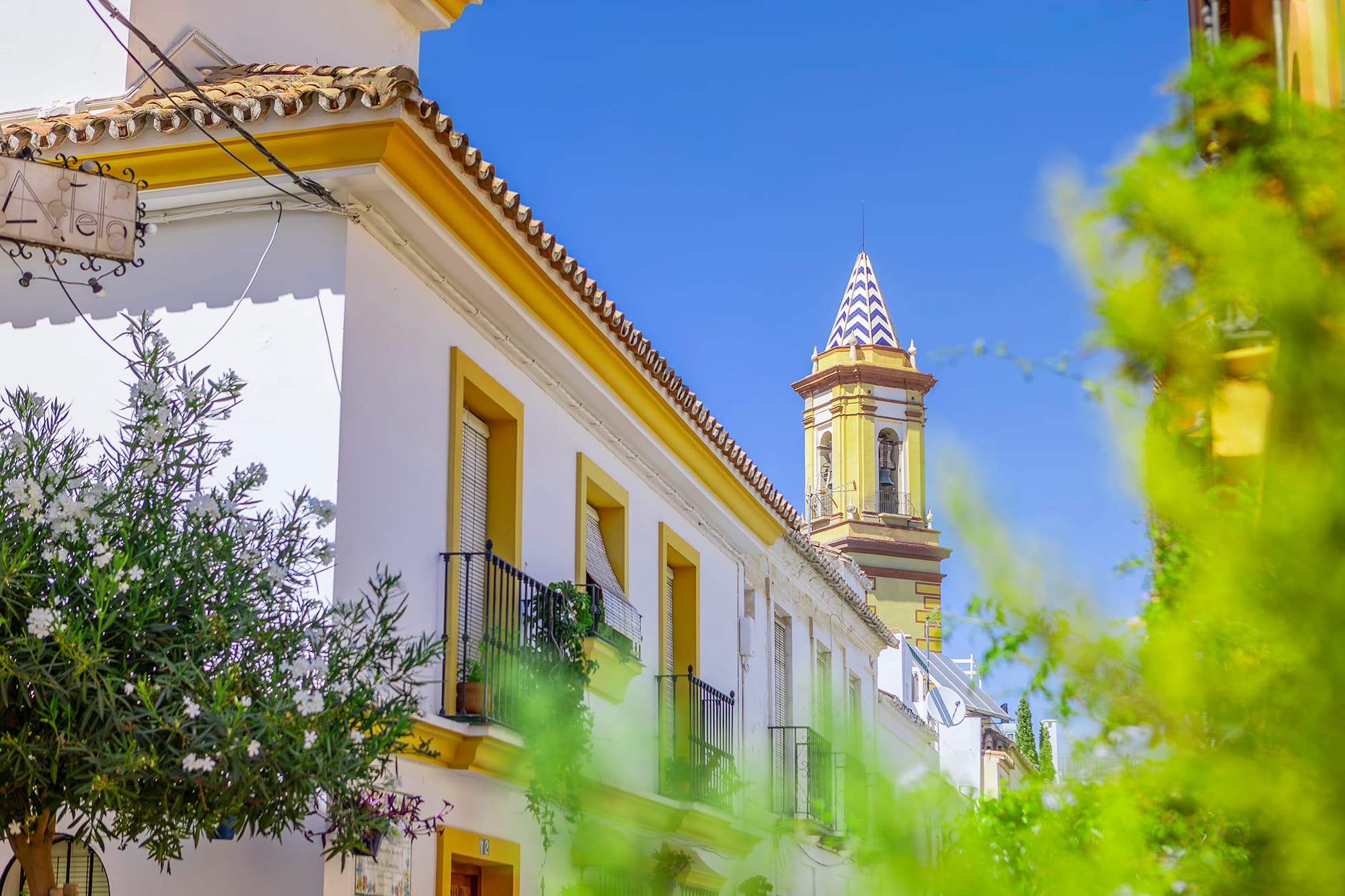
Flower-pot streets
After the tower, leave the main street. The best-kept streets are Carmen, Terraza and Carrera. If you wander off, no harm done: the old town is small and you always end up in a square.
See moreChurch of Los Remedios
The baroque façade of the Church of Los Remedios is worth a stop. Plaza San Francisco is a good place to rest a moment before continuing.
See more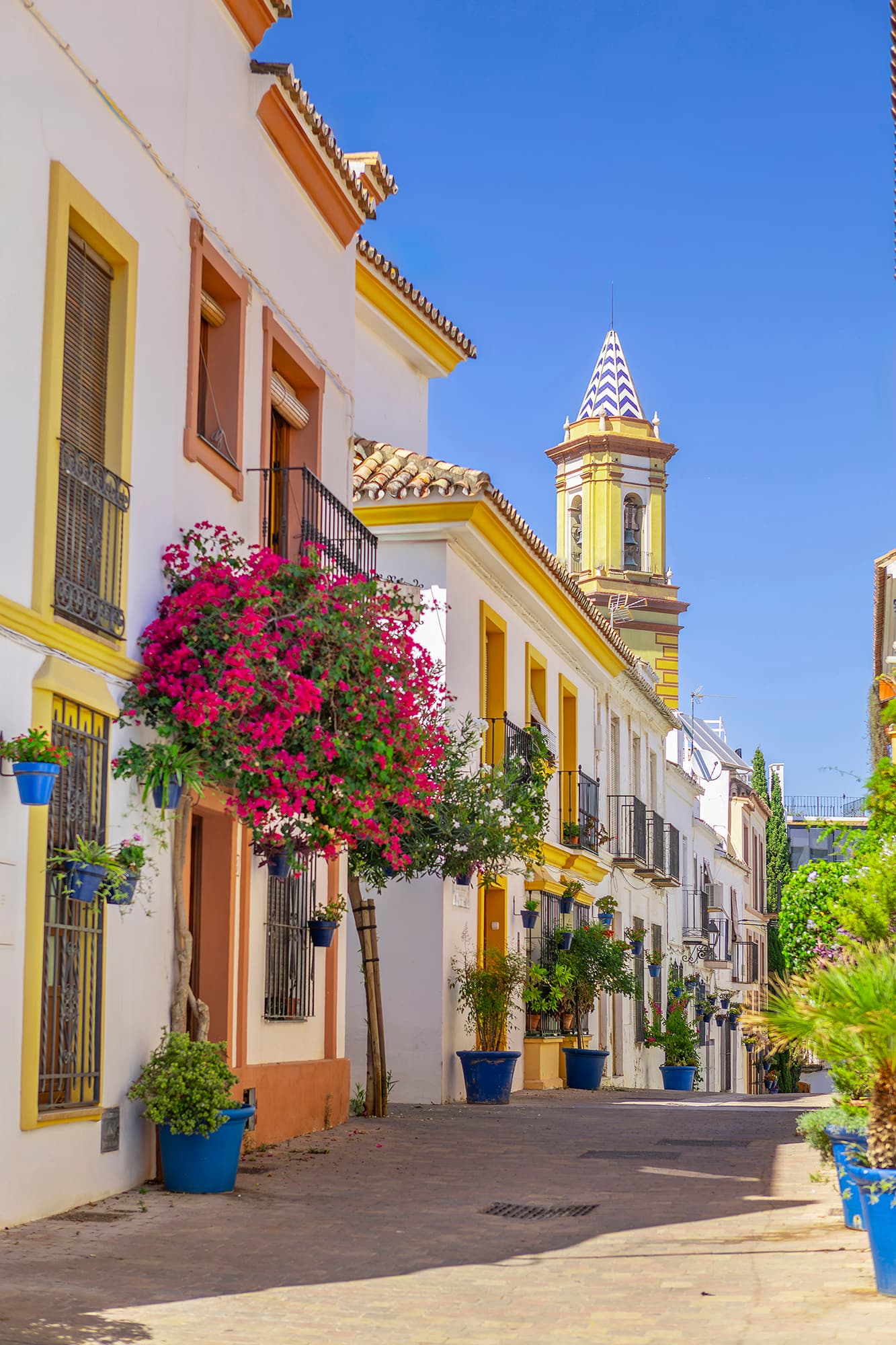
Castillo de San Luis
The remains of the 16th-century castle close the route. Calle Castillo leads directly there. You can go inside: a walkway follows its building phases.
See more
Stop for food or a drink
The old town has terraces and bars where you can end your walk. Or head to Mercado Santa Ana, a few minutes away, for something fresh and local.
See more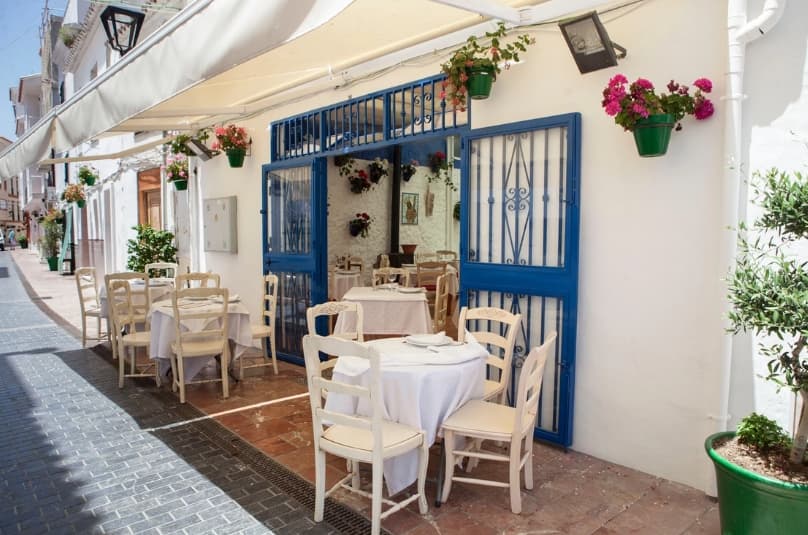
Must-see places
What to see in Estepona's old town
Historic squarePlaza de las Flores
The reference point of the old town. Colourful flower pots, whitewashed façades and the life of the neighbourhood concentrated in a small, intimate square. The most reproduced image of Estepona.
Tip: Best before 10am for photos without crowds.
See full profileHistoric monumentClock Tower
Four lives in one building: a 16th-century church tower, an 18th-century neoclassical belfry, a freestanding tower since the Lisbon earthquake of 1755, and a clock since the early 20th century. The most distinctive element of the historic skyline.
Tip: Visible from the outside at any hour. No ticket needed.
See full profile18th century · BaroqueChurch of Los Remedios
Estepona's main church, raised in the late 18th century over the old Veracruz chapel as the church of the Franciscan convent. Baroque façade on Plaza San Francisco. Centre of the cultural and religious life of the old town.
Tip: The façade from the street is worth more than any interior.
See full profile16th century · Open to visitorsCastillo de San Luis
Raised in the 16th century to strengthen the coastal defences and command the anchorage at La Rada. The remains were recovered in 2024 and can now be walked through inside, along a walkway that runs between the bastions and the display cases of excavated finds.
Tip: Calle Castillo leads directly to the remains. A very low entrance fee, free for local residents.
See full profileWalk · PhotographyFlower-pot streets
The flower pots aren't the council's: each neighbour waters their own. Carmen, Terraza and Carrera are the best-kept streets, and before eleven they're still quiet.
Tip: Explore secondary streets — the prettiest ones aren't on tourist maps.
See full profilePretty streets · Charming corners
Pretty streets and charming corners of the old town
The old town's flowers aren't planted by the council: each neighbour hangs and waters their own. It's an old custom that the award for Spain's most flower-filled municipality, in 1967, turned into part of the town's identity. You don't need to head anywhere in particular: put the map away and turn down the first street that catches your eye.
The most photogenic streets are usually the secondary ones, away from the main axis. Morning and late-afternoon light is most favourable for photographing façades and flowers.


74 art murals
Mural Route of Estepona
Estepona's old town is also an open-air gallery. More than 74 large-format art murals are integrated into the façades of the historic centre and adjacent neighbourhoods. Some fill entire buildings; others appear on alleyways almost nobody walks down.
The Mural Route covers the main ones, but the best discoveries are usually those on no list. Just walk with your eyes open.
See the Mural RouteHistory of the old town
The memory of Estepona's historic centre
Plaza de las Flores has had at least six different names throughout history. Beneath Casa del Aljibe lies a cistern of Muslim origin. The Clock Tower survived the Lisbon earthquake of 1755 and four centuries of transformation. Castillo de San Luis, raised in the 16th century to command the anchorage at La Rada, still shapes the urban fabric of the old town.
Estepona's old town is an open text. Every street, every name, every façade holds layers of time that are not always visible at first glance.
Archaeological heritage
The Roman secret of Calle Villa
Right on Calle Villa, a few steps from Plaza de las Flores, stand the remains of a 4th-century Roman tower that may have reached at least 12 metres in height: the base of an underground chamber, with masonry walls and a cobblestone floor. It was abandoned around the 6th century, and its materials — marble slabs, glass and rock-crystal tesserae covered in gold leaf — were looted at different times. Its exact function is still unresolved: municipal heritage sources hold two open hypotheses, neither confirmed — a funerary mausoleum tower, or a thynnoskopeion, a watchtower for the tuna fishing trap. Open to visit 24 hours a day, outdoors, with interpretive panels.
Visual archive
The old town in memory photos
Some old photographs help recognise how the historic centre has changed and which corners still form part of Estepona's memory.

Plaza de las Flores — historical image
Historical photo
Calle Real — historical image
Historical photo
Calle San Antonio — historical image
Historical photoWhere to eat near the old town
Tapas, fish and terraces steps from the historic centre
Around the old town there are bars, terraces and restaurants for tapas, fresh fish, a drink on a square or a leisurely dinner. Mercado Santa Ana, close to the old town, is also a good option for something fresh and local.
Getting there and parking
The old town is pedestrian-only: park nearby and walk in
The most central car park is Plaza Antonia Guerrero, underground and three floors, with 100 spaces and electric charging points: you come out on foot right into the old town. The Edificio Consistorial car park, under the town hall itself, has 131 spaces at a rate of 1 euro a day, reconfirmed in 2026. Both are a short walk from Plaza de las Flores.
Practical tips
Before visiting the old town
Walk it without a car or a strict map. The old town is small and hard to get lost in.
Comfortable shoes. The streets are cobbled and the surface can be uneven.
Best light for photos is first thing in the morning and late afternoon.
Combine with the seafront promenade, just a few minutes to the south.
The art murals are integrated into the old town and adjacent neighbourhoods. Worth keeping your eyes open.
If you want to eat at a restaurant at weekends or in high season, aim to arrive before 2pm.
The three harbour museums (Ethnographic, Palaeontological, Bullfighting) are free and about ten minutes from the old town.
In hot weather, prioritise a visit in the early morning or from 6pm onwards.
Frequently asked questions
Questions about Estepona's old town
Estepona's old town is in the historic centre of the city, around Plaza de las Flores, the Clock Tower and the Church of Los Remedios. It is entirely pedestrianised and easy to find from anywhere in the centre.
A relaxed visit without rushing takes between one hour and an hour and a half. If you add stops for a drink, exploring secondary streets or going into the church, it can take two hours or more.
Plaza de las Flores is the essential reference point. The Clock Tower, the Church of Los Remedios, the flower-pot streets and the remains of Castillo de San Luis complete the main landmarks of the historic centre.
Plaza de las Flores is the most well-known and photographed square in Estepona. Colourful flower pots, whitewashed façades and the life of the neighbourhood concentrated in a small, intimate space.
Yes, it is a pedestrian zone. The old town is explored exclusively on foot, with no cars and no tickets to buy. The streets are narrow, cobbled and completely accessible for a leisurely visit.
Yes. In the area around the old town there are bars, terraces and restaurants for tapas, fresh fish or a drink on a square. Mercado Santa Ana is also nearby.
Yes. The old town is calm, pedestrianised and easy to walk around. No tickets or set hours needed. The flower-lined streets and the art murals tend to be popular with children.
The seafront promenade, the art murals integrated into the old town and adjacent neighbourhoods, the sports harbour with its free museums, and the boulevard are all close by and complement the visit to the historic centre well.
First thing in the morning, before 11am, the streets are quiet, the light is side-lit and the atmosphere is especially pleasant. Late afternoon, from 6–7pm, is also a good option.
Plaza de las Flores, the streets with flower pots and bougainvillea, the archways, the Clock Tower and the façade of the Church of Los Remedios offer the best photographic possibilities. Morning and late-afternoon light is most favourable.
Keep discovering
Keep discovering Estepona
Places of interest
All points in the old town and surroundings
ExploreWalking routes
Charming corners, murals, sculptures and more
ExploreWhere to Eat
Restaurants and bars nearby
ExploreMemory Photos
Visual archive of the historic centre
ExploreInteractive map
Locate all points on the map
ExploreHistory
Urban memory, people and archive
ExplorePlan your visit
Not sure where to start?
Combine the old town with beaches, restaurants and gardens. Tell us how much time you have and we'll design your perfect day in Estepona.