


History of Estepona
What the guides leave out.
Independence in 1729, 124 fishermen of the 18th century, the mayor who built the seafront promenade and the first tourism website for Estepona. Real stories with names, dates and sources.
Browsing by era
Prehistory and archaeology
5,000+ years ago
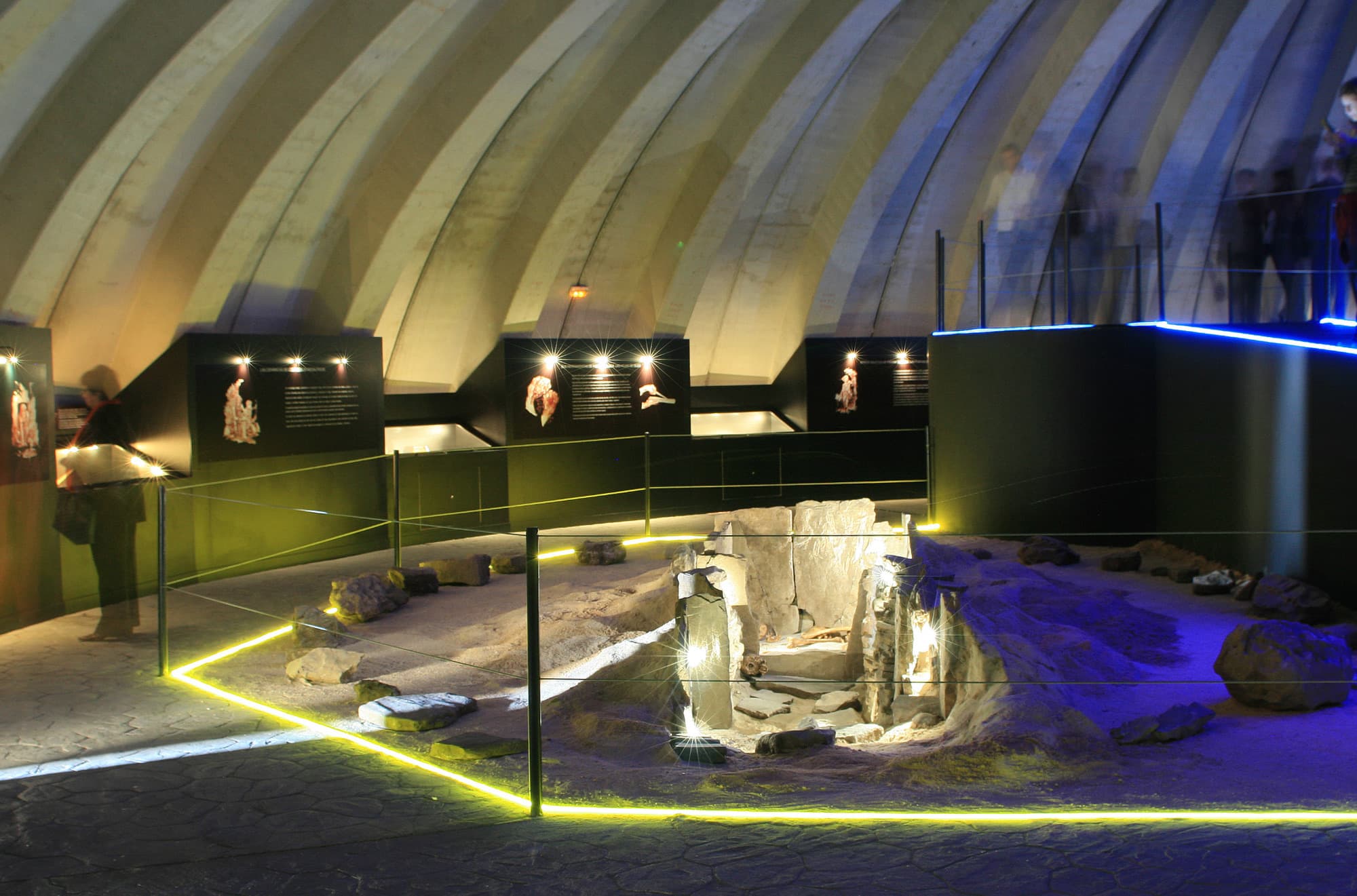
- Hace unos 5.000 añosPrehistoryThe 5,000-year-old cemetery uncovered while building a motorwayThe Necropolis of Corominas is a megalithic site from the final Neolithic and Chalcolithic periods, found between 2000 and 2001 during preliminary works for the Costa del Sol toll motorway and excavated between 2001 and 2002. It contains five well-preserved megalithic tombs, dating back some 5,000 years, and several Bell Beaker-period burials from the early Bronze Age. As the motorway route could not be rerouted, the tombs were dismantled and rebuilt in an interpretation centre under a burial mound in Parque San Isidro Labrador, now open to visitors by prior reservation.
- Siglos III – I a. C. (hipótesis; hay también cerámica medieval documentada)Archaeological heritageThe site catalogued since 1994 that no one has ever excavatedCerro Patraina is an archaeological site catalogued in Estepona's urban planning since 1994, on a hill above the municipality's western coast, between Corominas and Arroyo Vaquero. According to the municipal Archaeological Survey record, it occupies the hilltop, 68 metres above sea level, with an estimated area of about 300 m², and is defined as a watchtower with wide visual command: under the vegetation that covers it, a walled perimeter of ashlar blocks has been made out. The chronology remains open — the original survey documented medieval-period pottery at the site, though a pre-Roman hypothesis (3rd–1st century BC) is also proposed today, based on the type of ashlar, with a parallel cited at Alcorrín (Manilva). Two preventive archaeological interventions, in 2008 and in 2020, surveyed the area around the hill for two separate development projects (Sector SUNP-01 and Sector SUP-02 "La Gaspara"); both focused on the slopes and access routes, not the summit, and both conclude that the site itself, if it matches its catalogue description, remains untouched.
- Hace más de 5.000 añosPrehistoryThe 5-centimetre clay figure the town council declared a symbol of the cityThe Venus de Estepona is a small fired-clay figurine about 5 centimetres tall, with a schematic female shape, found in August 2011 at a prehistoric 'pit field' site within the municipality, alongside hand-made pottery, flint arrowheads, polished stone axes, necklace beads and other stone idols. It is over 5,000 years old and, according to the town council, the only piece of its kind found in excavations in Málaga province. It is interpreted as an amulet or fertility symbol linked to the rituals of the time. It is on display at Estepona's Municipal Archaeological Museum; the town council began the process of declaring it an official symbol of the city in 2014, a process formally approved by the regional government (Junta de Andalucía) in early 2015.
- Hace más de 128.000 añosPrehistoryThe 128,000-year-old stone tools that redraw Estepona's mapAt Las Mesas de Saladavieja, in the municipality of Estepona, an archaeological survey required by local planning rules — ahead of development in an area with known remains — uncovered several hundred stone artefacts over 128,000 years old, from the Lower Palaeolithic. They are stone tools, mostly made from sandstone river cobbles and, to a lesser extent, limestone and flint, used to cut, work hides, strike or extract fat from animals. According to the archaeologists behind the find, it is the first excavated site of its kind on the Western Costa del Sol. The dig, authorised by the Junta de Andalucía and led by archaeologist Cibeles Fernández (Arqueotectura), included a lithic study by prehistorian Luis Pérez Ramos, a specialist in Andalusian Palaeolithic archaeology. The team published the results in 2021 in the academic journal Mainake, extending the site's chronology into the Middle Palaeolithic (Mousterian) as well. The pieces are now part of the Estepona Municipal Archaeological Museum's collection, in a space dedicated to the Palaeolithic.
- Desde el siglo VI a. C.Phoenicians and PunicsThe Phoenician settlement that exported fish sauce to AthensEl Torreón is a Phoenician-Punic settlement on a headland on the right bank of the mouth of the Guadalmansa river, in the municipality of Estepona. According to the town council, it was founded from the 6th century BC and was dedicated to producing fish salting and sauces — some amphorae were exported as far as Athens — plus farming, livestock and iron and, especially, copper mines at the headwaters of the Guadalmansa itself. The settlement remained inhabited into the early Roman period; according to Andalucia.com, occupation lasted around eight hundred years, until roughly 200 AD. Some academic sources identify it with Salduba, a city named in classical sources, though that identification has been a disputed hypothesis since the late 19th century, not a settled fact. Most of the Municipal Museum's collection from the site came from Luis Soto's 1974 excavation. El Torreón is a different site from the Villa Romana de las Torres, the Roman bath complex declared a Site of Cultural Interest that stands beside the Guadalmansa watchtower, in the same area.
- Origen prerromanoToponymyEstepona's name is older than the Arabic it was first written inAccording to Toponomasticon Hispaniae, a research project funded by Spain's Ministry of Science and Innovation with several Spanish universities taking part, Estepona's place name does not originate in Arabic. It comes from a pre-Roman root, *Istippona, whose meaning is unknown. Linguist José A. Correa, cited by the project, reconstructs the original form as *Istippo / Istipponis, related to other place names in the same area — Acinippo, Baecippo, Baesippo, Ventippo — which share the same [ist-] and [-ipp] segments. Correa finds no support for a Phoenician-Punic origin and instead proposes a Tartessian-Turdetanian one, within the same group of place names in [-ipp]. The oldest surviving written form of the name, however, is the Arabicised one: no earlier text has survived. From there the name passes into Castilian chronicles — the earliest verified instance, Diego Enríquez del Castillo's Crónica de Enrique IV, already writes "villa de Estepona" — down to the form used today.
Shared memory
Do you have a memory of Estepona worth telling?
Many stories from this town only live on in family memory. If you have a photo, a document or a real story with a name and a date, write to us.